Guide3 min read
What a colonia is, and why the address on the map matters
Most supporters have never heard the word. Understanding what a colonia is explains nearly every decision we make about where the food, the repairs and the health screens go.
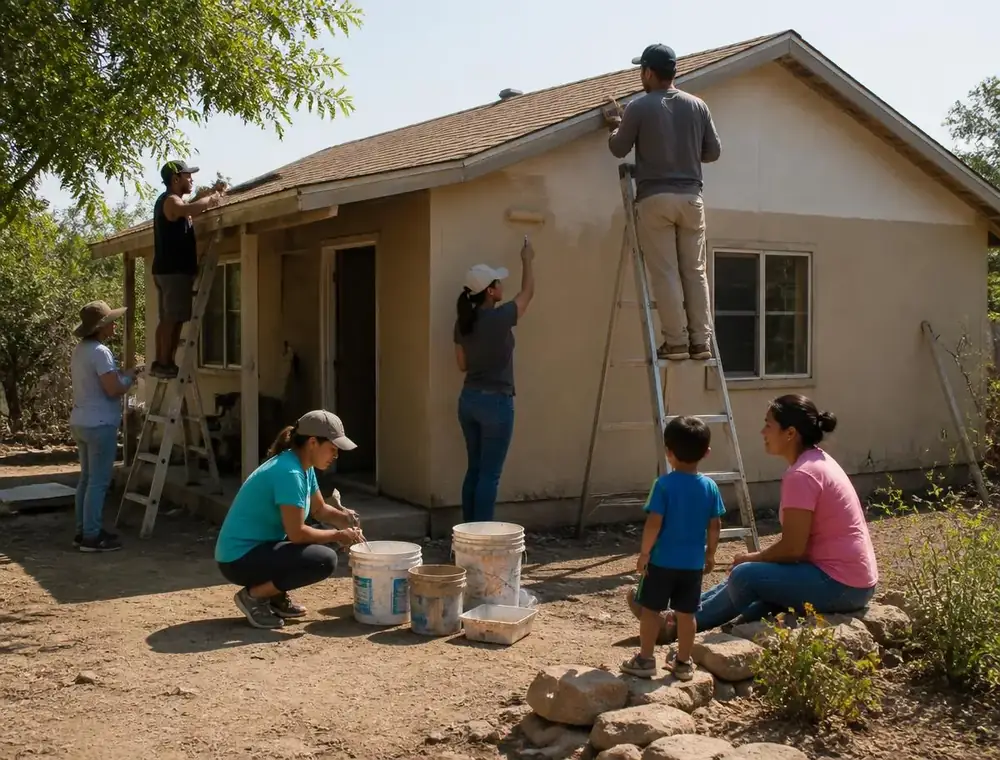
When we describe our work, the word colonia does most of the load-bearing. It is worth explaining plainly, because almost every operational choice we make follows from what a colonia is.
A colonia is an unincorporated residential settlement along the Texas–Mexico border. Many were created decades ago when agricultural land was subdivided into small lots and sold — often on contract, often to low-income buyers — without the infrastructure a city would have required: no paving, no drainage, sometimes no potable water or sewer connection at the outset. Texas has hundreds of them, concentrated in the border counties, and the four counties of the Rio Grande Valley — Cameron, Hidalgo, Willacy and Starr — contain a large share.
Being outside the city limits changes everything
Because colonias sit outside municipal boundaries, the ordinary machinery of a city does not automatically reach them. There is no city bus. Street lighting may be sparse. Drainage during a heavy rain event can flood streets and yards for days. Trash pickup, code enforcement and address standardization all work differently than they do six miles away inside city limits.
That geography is the reason our food distributions run out of neighborhood churches instead of one central pantry, the reason health screens travel to the community rather than expecting the community to travel, and the reason a school-supply table at the end of the street reaches families that a county fairground event never would.
Housing built in stages
Colonia housing is frequently self-built over years, as money allowed. A family pours a slab, frames a room, moves in, and finishes the rest whenever there is cash. The result is a house that is standing but unfinished: exposed studs, a roof that was always meant to be temporary, no siding on one wall, a bathroom that was never plumbed, windows covered in plastic.
This is exactly the kind of work a short-term team can finish well. A group of ten with a week, a plan and a materials budget can dry in a roof, close in a room, or paint an entire block. It is also why we scope projects before a team arrives — an unfinished house has no drawings, and someone has to walk it, measure it and price it in advance.
Poverty concentrated by geography
A Center for Public Policy Priorities study, cited in Baptist Standard's reporting on our work, found 68 percent of children in the Rio Grande Valley live in high-poverty neighborhoods. That is not a figure about individual family income; it is about the concentration of it — whole neighborhoods where nearly every household is in the same position, so the informal safety net of a better-off neighbor barely exists.
Concentration is what makes a church-based model effective. When need is spread thinly, you build a central service and people travel to it. When need is concentrated by street, you go to the street — and the institution already on that street, usually a small congregation, becomes the most efficient distribution point available.
Not a story about deficiency
One thing worth saying plainly, because outside coverage often gets it wrong: colonias are not chaotic places. They are neighborhoods, with long-tenured homeowners, businesses run out of front rooms, deep family networks and churches that have served the same blocks for decades. Most residents are U.S. citizens. What is missing is infrastructure and capital, not competence or effort.
Our role is narrow and we try to keep it that way: bring the material resources and the extra hands that local leaders already know how to deploy. The pastor knows which roof is worst. We help buy the shingles.
Be part of the next update
Food, home repairs and school supplies across the Valley are funded entirely by people who choose to give. Hearts 4Kids is a 501(c)(3) public charity.
Get the next update by email
A short email every few weeks: field updates, program news and the occasional story from the center. No spam, unsubscribe any time.
Prefer a reader?Subscribe to our RSS feed