Field update3 min read
Why the food has to come to the neighborhood
Many colonias sit outside city limits, off any bus route and miles from a grocery store. Here is how our church-hosted distributions work, who they serve, and what we learned in 2020.
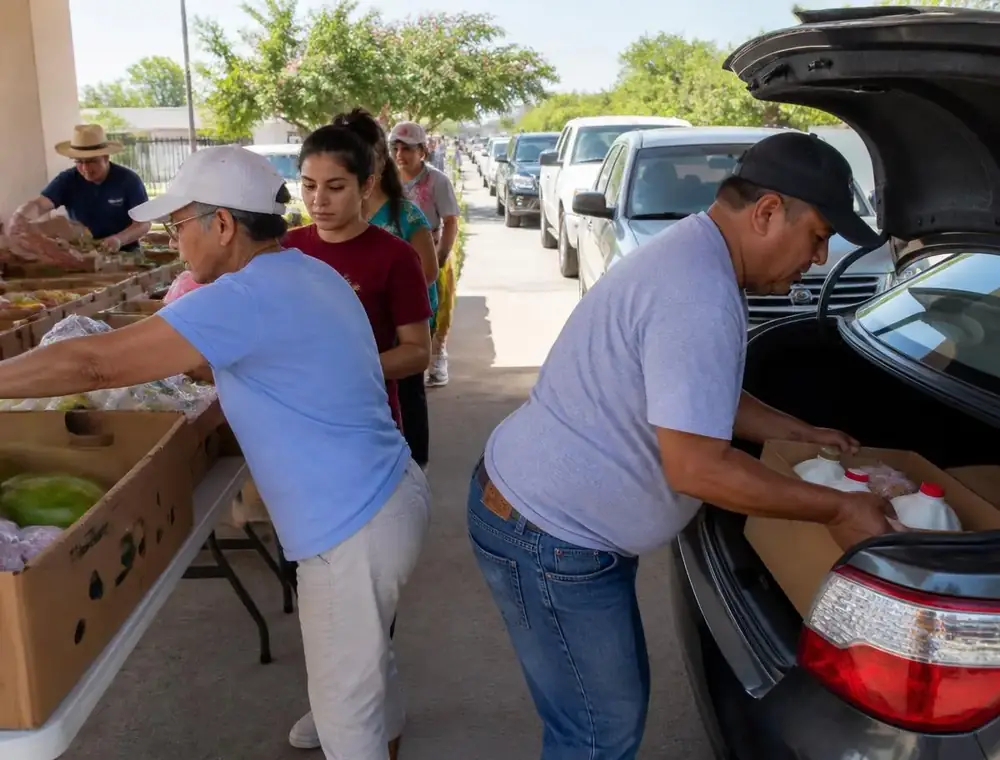
A food pantry twenty minutes away by car may as well not exist for a household without a car. That single fact shapes how food moves across the Rio Grande Valley, and it is the reason our distribution model looks the way it does.
Colonias are unincorporated settlements along the Texas–Mexico border, many of them developed decades ago on cheap agricultural land sold in small lots without infrastructure. Streets can be unpaved. Water and drainage vary. What they nearly all have in common is distance: they sit outside city limits, beyond municipal bus routes, and often several miles from the nearest full grocery store. The corner store that is within walking distance sells snacks and soda at convenience-store prices, not a week of meals.
The model: distribute where people already are
Instead of one central warehouse and one pickup window, we work with a network of more than 70 churches spread through the colonias, a network built out over years and documented in reporting on our 2020 pandemic response. Each host church runs distributions in its own parking lot or fellowship hall, close enough that families can walk, staffed by volunteers who are neighbors rather than strangers.
Practically, a distribution day looks like this. Pallets and boxes are staged early in the morning, before the heat. Volunteers form a packing line and build boxes of shelf-stable staples — rice, beans, pasta, canned protein, oil, masa — plus whatever fresh produce is available that week. Both a drive-through lane and a walk-up table operate, because roughly speaking half of the households arriving on foot would be excluded by a drive-through-only setup. Anyone still in line when the boxes run low gets partial contents rather than nothing.
What the 2020 response taught us
During the COVID-19 shutdown, that network moved food to roughly 6,000 people a week, with more than 750 volunteers turning out across the Valley — figures reported by CBF in September 2020, when the fund supporting the effort was covered. Those months proved the model under maximum load and taught three lessons we still run on.
First, the bottleneck is almost never food; it is volunteers, refrigeration and vehicles. Second, trust routes faster than logistics — families showed up at churches they already knew and stayed away from unfamiliar sites even when those were closer. Third, the relationships built in a crisis are the reason ordinary weeks still work: a pastor who fed a family in April 2020 is the person that family calls in 2026 when the roof leaks.
Who gets served
Anyone who comes. There is no membership requirement, no faith requirement, no income paperwork and no questions about documentation status. When supply is short, households with young children, elderly residents and families who have just lost income are prioritized — and the host pastor makes that call, because he knows which of those things is true this week.
If you need food help in the Valley
If you are reading this because your own household is short, start with the church nearest you that hosts a distribution; ask a neighbor, or call or email us and we will point you to the closest site and day. Bring something to carry boxes in if you can. You do not need to bring documents. If you are homebound or have no way to travel, tell us — some sites can arrange a delivery through a volunteer already headed that way.
If you want to help
Cash goes furthest, because it lets us buy in bulk at food-bank pricing rather than retail, and buy locally so the spending stays in the Valley economy. After that, the most valuable contribution is hands: a distribution needs people to pack, load, direct traffic and translate. Groups of six to twenty fit a distribution day well. Skilled volunteers with a truck, a trailer or a commercial license are worth their weight several times over.
Be part of the next update
Food, home repairs and school supplies across the Valley are funded entirely by people who choose to give. Hearts 4Kids is a 501(c)(3) public charity.
Get the next update by email
A short email every few weeks: field updates, program news and the occasional story from the center. No spam, unsubscribe any time.
Prefer a reader?Subscribe to our RSS feed