Program news3 min read
Back-to-school season: backpacks, shoes and a lot of new notebooks
The first week of school is the most expensive week of the year for colonia families. Here is exactly how our supply distributions work, what a child actually needs, and how to help.
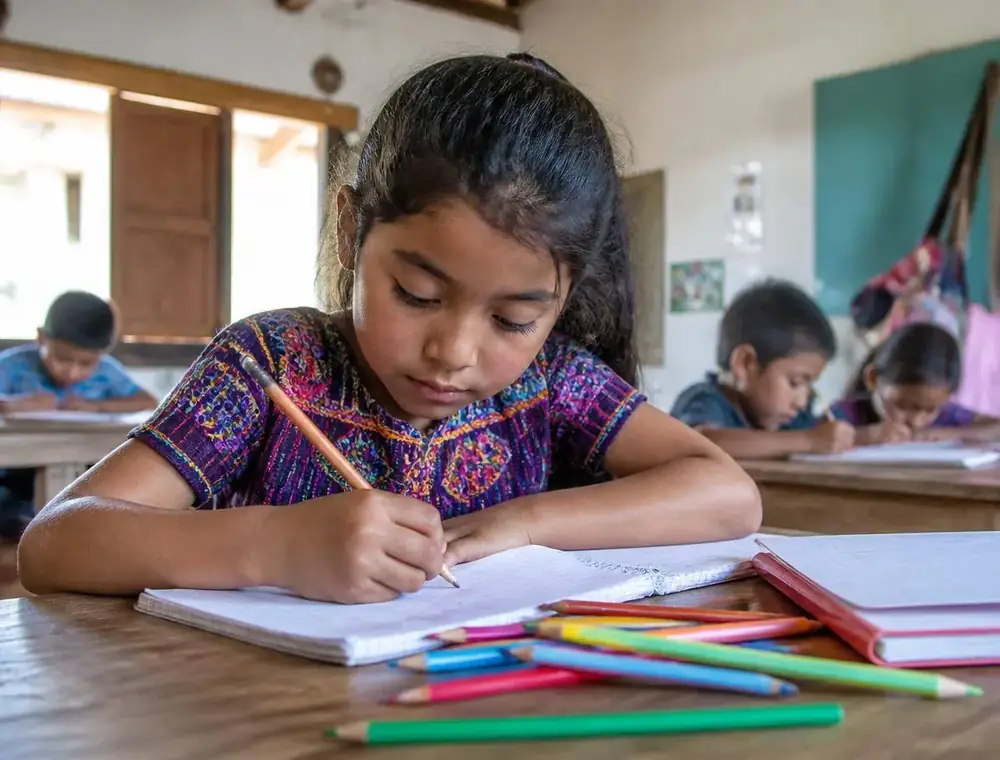
Texas public school is free. The things a child needs to walk through the door on the first day are not. A backpack, a set of notebooks, folders, pens, glue, a calculator for the older students and a pair of shoes that fit can add up to more than a week of household income — and it all comes due in the same few days of August, at the same time the electricity bill peaks because it is 100 degrees outside.
For families in the colonias, that pinch point is why some children start the year with borrowed materials, or without the supply list the teacher sent home. Children notice who came unprepared. Teachers notice too, and quietly buy the difference out of their own pockets. Our back-to-school distributions exist so that neither has to happen.
What a supply list actually costs
Supply lists in Valley districts vary by campus and grade, but the pattern is consistent. An elementary student typically needs a backpack, wide-ruled composition books, pencils, crayons or colored pencils, glue sticks, scissors, folders and tissue or sanitizer for the classroom. A middle schooler adds binders, dividers, graph paper and a basic scientific calculator. A high schooler often needs a graphing calculator, which alone can cost more than every other item combined.
Add closed-toe shoes and a few sets of uniform-code clothing and a single child's start-of-year cost lands in the range most families here cannot absorb without dropping something else. With three or four school-age children in the house, it is not a stretch — it is impossible.
How we distribute
Supplies go out through the partner churches in each colonia rather than from a central office. That single decision matters more than anything else about the program. A distribution point three miles away on a road with no sidewalk and no bus route is not accessible to a family without a car; a table set up at the church at the end of their own street is.
Pastors work through their lists family by family before the distribution day, checking what each child actually needs instead of handing out identical kits. A first grader and a tenth grader need very different things, and a child who already has a usable backpack does not need a second one — that backpack should go to the child next door who has none. Visiting mission teams help sort, count and pack in the days beforehand.
Several churches pair the distribution with a block party: music, food, games, a bounce house if someone can borrow one. It changes the feel of the day from a handout line into something a child is glad to be seen at. That matters. Dignity is not a soft extra in this work; it decides whether a family comes back next time they need help.
What we ask families
Very little. There is no income verification, no membership requirement at the host church, no questions about documentation status. If a parent shows up and says they have two children starting school, we believe them. The cost of occasionally giving a backpack to a family that could have afforded one is trivially small compared to the cost of turning away a family that could not.
How you can help
Every backpack we hand out is paid for by someone who gave. A one-time gift covers supplies for a specific number of children; a monthly gift lets us buy earlier in the summer, when stock is available and prices are lower, instead of scrambling in the last two weeks of August.
Supply drives are genuinely welcome, with one request: email us before you start collecting. Every year we receive generous donations of things nobody needs and run short on the boring items — plain wide-ruled composition books, sturdy backpacks in neutral colors, and shoes in the sizes children actually wear. A five-minute conversation makes a drive twice as useful.
If your church or company wants to adopt a specific colonia's list for the year, that is the most useful commitment of all, because it lets the local pastor promise families something before the school year starts rather than hoping it comes together.
Be part of the next update
Food, home repairs and school supplies across the Valley are funded entirely by people who choose to give. Hearts 4Kids is a 501(c)(3) public charity.
Get the next update by email
A short email every few weeks: field updates, program news and the occasional story from the center. No spam, unsubscribe any time.
Prefer a reader?Subscribe to our RSS feed